



Messages
-
Fukutake SoichiroHonorary Chairman, Fukutake Foundation
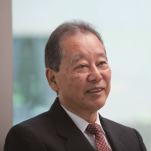
For me, the Naoshima New Museum of Art is the culmination of what I have done for over the past thirty five years. For this initiative we will place our focus on Asian art. The works in the collection of Benesse Art Site Naoshima will hence extend from the West to Asia, including Japan. It is my hope that the new museum will symbolize a bright future by contributing to the formation of happy communities.
Director of Benesse Art Site Naoshima; General Producer of the Setouchi Triennale; General Producer of the Echigo Tsumari Art Triennale; Honorary Chairman of Fukutake Foundation; and Honorary Advisor of Benesse Corporation, Inc. Joined Fukutake Publishing in 1972 and became the CEO in 1986. Became the CEO and Chairman of Benesse Holdings, Inc. in 2007, then Honorary Advisor since October 2016.
-
Fukutake HideakiChairman, Fukutake Foundation
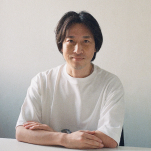
Once completed, buildings and works of art tend to be seen as being in their final states. Isn’t it possible, however, to create something new, such as "movements" or "circulation" even after the “completion”? For Benesse Art Site Naoshima, Naoshima New Museum of Art will play a role as a platform to promote "movements" as such. With the museum as a base, I hope we will generate new "movements" through conversations and collaborations not only between artists and architects but across a wide spectrum of encounters and exchanges including those between islanders and visitors.
Chairman of Fukutake Foundation; Chair of the Board of Directors of Benesse Corporation, Inc. After working for KEYENCE CORPORATION, and SMS Co., Ltd., Fukutake founded efu Investment Ltd. in New Zealand and overseeing various companies such as Metro, World of Wearable Art, DDMMYY, and Hulbert House. Founded Still, Ltd. in 2020 and has conducted diverse cross-generational and cross-border business endeavors and aims at fostering a new culture that transcends borders and generations. Has serves as Chairman of Fukutake Foundation since January 2023.
-
Tadao AndoArchitect
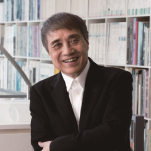
I believe it was, more than anything, Mr. Fukutake Soichiro's enthusiasm and passion that led Naoshima to flourish as a world-famous island of art and culture. While there are a number of wonderful art museums around the world, I have not seen many that demonstrate the personal senses of an individual as vividly as the one in Naoshima does. Working on this new museum project, more than thirty-five years since I first met Mr. Fukutake, I am drawn more than ever to follow his liberal spirit and strong will now and going forward into the future.
Born in Osaka in 1941. A self-taught architect who founded Tadao Ando Architects & Associates in 1969. Notable works include Church of the Light (Osaka, 1989), Chichu Art Museum (Naoshima, 2004), Nakanoshima Children’s Book Forest (Osaka, 2020), and Bourse de Commerce / Pinault Collection (Paris, 2021). Recipient of many notable awards including the Architectural Institute of Japan Prize for "Row House in Sumiyoshi" (1979), the Pritzker Architecture Prize (1995), the Gold Medal of UIA (2005), Order of Culture (Japan, 2010), Commandeur de l'Ordre des Arts et des Lettres (France, 2013), Commandeur de la Legion d’Honneur (France, 2021). Professor at the University of Tokyo since 1997, currently professor emeritus.
-
Miki AkikoDirector, Naoshima New Museum of Art
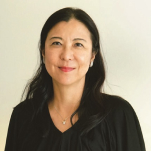
Benesse Art Site Naoshima launched in the late 1980s on the eponymous island in Japan to engage with society and the times, and offer new values through the pursuit of artistic activities on remote islands different from those available in cities, and with the aspiration of building a community in cooperation with locals, and shaping a symbiosis of nature, architecture, and art.
Located in a village and the first to be named after the island, Naoshima New Museum of Art is the latest addition to the nexus of museums and art facilities developed by Benesse Art Site Naoshima on the islands of Naoshima, Teshima, and Inujima. This both encapsulates the idea of creating an art museum that contributes to regional revitalization in association with locals on the island where Benesse Art Site Naoshima's activities originally began, and endeavors to further deepen that symbiosis of art, architecture, nature, and community. With a focus on exhibiting and introducing contemporary art from Asia, including Japan, Naoshima New Museum of Art's wide-ranging projects encompass changing exhibitions and public programs. As a node for the nexus of museums that Benesse Art Site Naoshima's thirty-year project has yielded, this new venue aspires to disseminate diverse perspectives and messages about contemporary society, attract both islanders and people from around the world, and inspire fresh encounters, exchange, insights, imagination, and creativity.
The “new” in the name not only emphasizes a spirit of critical inquiry into different perspectives, the zeitgeist, and society through art and other broader activities, but also reaffirms the creation of new values through Benesse Art Site Naoshima's long-term efforts, and incorporates a desire to look ahead to a future century hence and continue to question and challenge existing values through art.
Naoshima New Museum of Art joins Benesse Art Site Naoshima at a time of political, economic, and social transition, and it is our hope that the museum will create highly diverse viewing experiences through works of art and collaborations with Asian artists astutely examining the circumstances and era in which we live, and will encourage reflection on “benesse=well-being” through perspectives that are local, Asian, and global.International Artistic Director of Benesse Art Site Naoshima, Miki Akiko was chief and senior curator of Palais de Tokyo, Paris, from 2000 to 2014. Her curatorial experience includes such major international exhibitions as the Yokohama Triennale (artistic director, 2011, and co-director, 2017) as well as roles as a guest curator at Barbican Art Gallery (London), Taipei Fine Arts Museum, National Museum of Modern and Contemporary Art, Korea, Mori Art Museum (Tokyo), Yokohama Museum of Art, and Kyoto City KYOCERA Museum of Art, among other notable museums in Japan and overseas.
Architecture
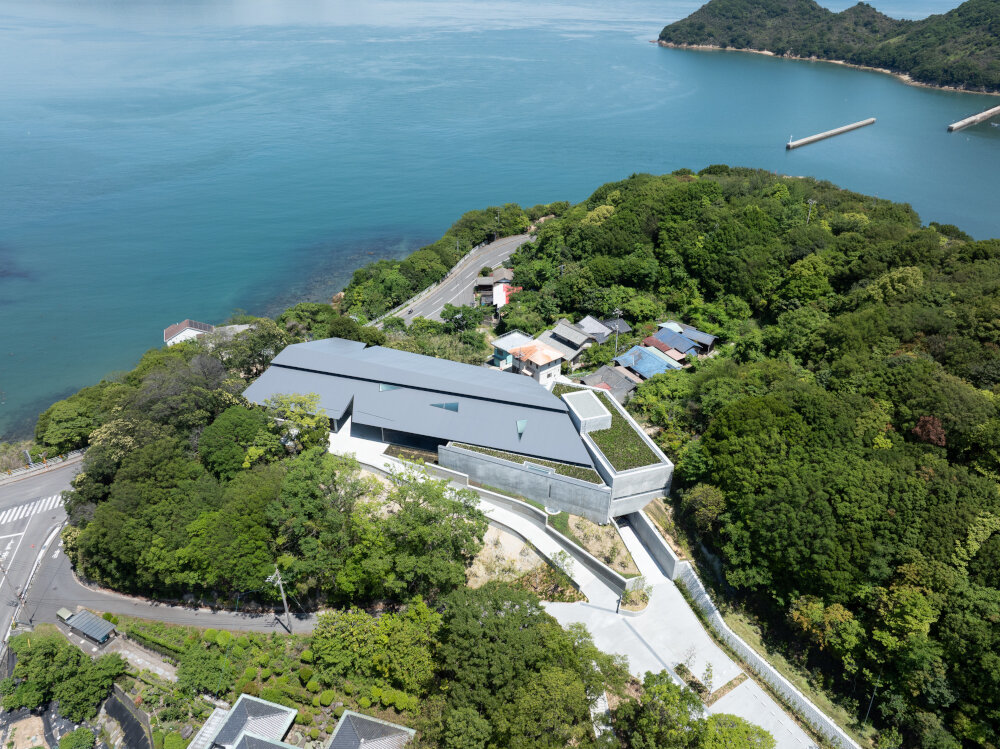
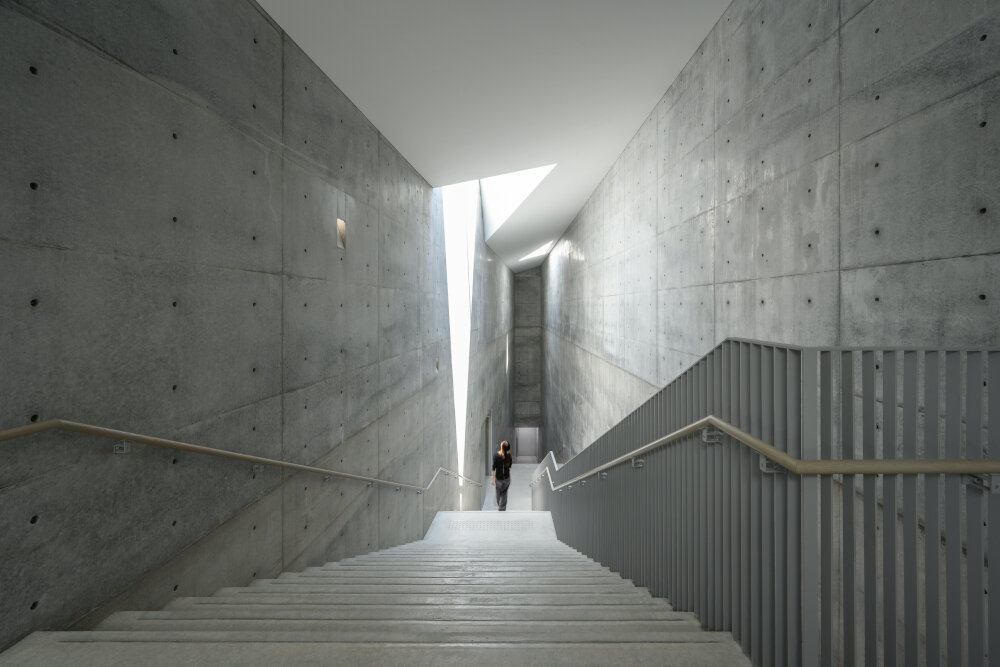
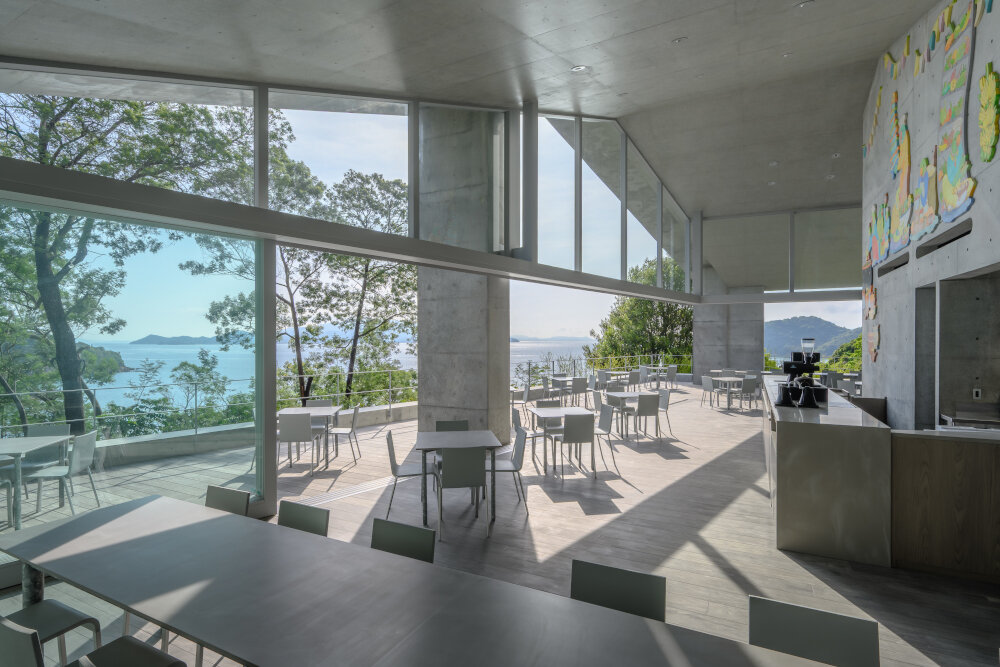
The architecture of the Naoshima New Museum of Art is designed by Tadao Ando, who has worked on museum projects for Naoshima for over three decades beginning with Benesse House Museum, which opened in 1992. Featuring a large roof whose slope resonates with the hilltop location, the new three-story museum has two floors underground and one on ground level. A staircase room, where natural light enters from a skylight, extends downward, straight from the ground level to the underground floors. Located on both sides of the staircase are four galleries. There is a café on the northern part of the ground floor, which offers a scenic view of the island of Teshima and fishing boats coming and going, a characteristic vista of the Seto Inland Sea.
The exterior of the museum features black plaster reminiscent of burned cedar walls, and a stacked pebble fence to blend with the surrounding landscape of the Honmura area. The architecture and the approach leading up to the entrance are designed to connect the experience of visitors with Naoshima's history and people's lives.
Logo
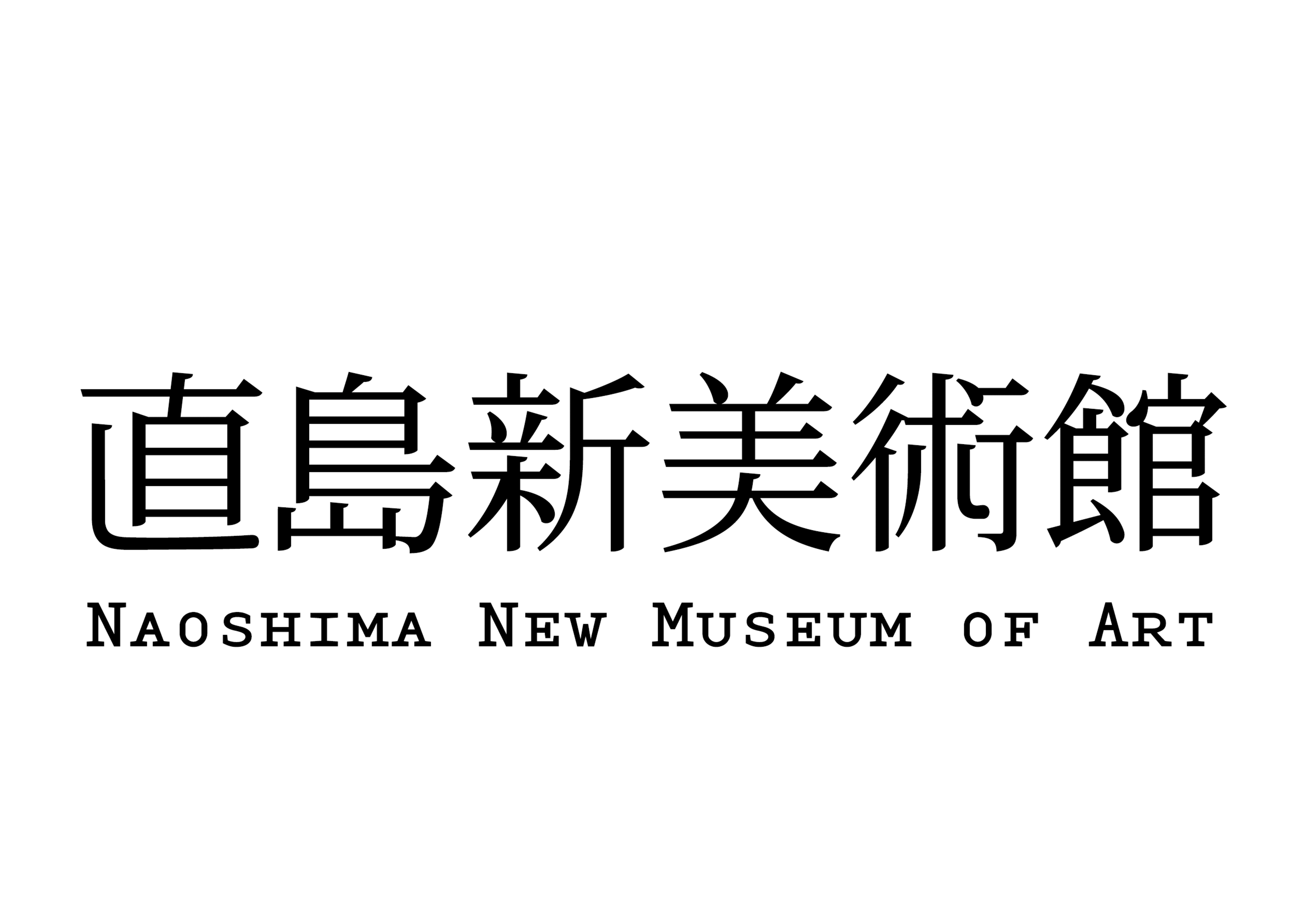
The logos for Chichu Art Museum and Teshima Art Museum used Mincho fonts from differing periods. The structure of the Japanese characters for the Naoshima New Museum of Art logo is based on the flat style of Mincho typeface for newspapers, which was in use from around 1941. By reducing the difference in the vertical and horizontal thickness, this Mincho font remains legible even for smaller sizes of type. The Japanese character for “Nao” has a gentle final stroke, as used by Fukutake Foundation when it was first established. The Roman script is a slab typewriter font rationally designed for consistent letter spacing. The choice of Japanese and Roman typefaces mean the Naoshima New Museum of Art logo can adapt as times change in the centuries to come.
Sobue Shin
-
Sobue ShinArt Director
1959 - 2026. Born in Aichi Prefecture. Sobue Shin is an art director and the director of Cozfish. A master at creating extraordinary and enchanting works, he works across design disciplines, including book and exhibition design as well as merchandise branding. He designed the logos for Chichu Art Museum and Teshima Art Museum, provided art direction for Snoopy Museum Tokyo, and has handled graphic and merchandise design for many exhibitions, including ones about Miffy, Evangelion, Momoko Sakura, and Hokusai. Sobue is a member of TDC and AGI.